Exam simulation
Lecture 6 · Communications Engineering · University of Klagenfurt, 2023
This lecture
Lecture 6 of 6
- The exam simulation, solved in class
- The written exam of February 2024, with its solutions
Each paper has three exercises, one per part of the course, for 120 points in two hours; 60 points pass.
From Communications Engineering at the University of Klagenfurt, first taught in 2020: this is the edition of winter 2023, so some of it may be a little dated. All lectures.
The exam simulation
01
Exercise 1: Fourier series and transform
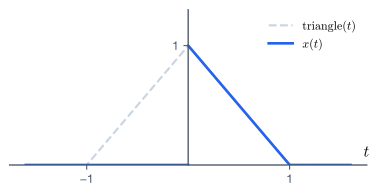
Let x(t)=\mathrm{triangle}(t)\cdot\mathrm{rect}\left(t-\frac12\right). (50 points)
- Evaluate the area and the energy of x(t).
- Compute the Fourier series of the periodic version x_p(t)=\sum_{h=-\infty}^{+\infty}x(t-hT_0), with period T_0=2.
- Compute the Fourier transform X_+(f) of x(t)+x(-t).
- Compute the Fourier transform X_-(f) of x(t)-x(-t).
- Compute the Fourier transform X(f) of x(t).
Exercise 1: solution
x(t)=1-t for 0<t<1, zero elsewhere. 1. A(x)=\frac12, E(x)=\int_0^1(1-t)^2dt=\frac13.
2. f_0=\frac12:
A_0=\frac12,\qquad A_k=\int_0^1(1-t)\cos(\pi kt)\,dt=\frac{1-(-1)^k}{\pi^2k^2}=\frac12\mathrm{sinc}^2\left(\frac k2\right),\qquad B_k=\int_0^1(1-t)\sin(\pi kt)\,dt=\frac{1}{\pi k}
3. x(t)+x(-t)=\mathrm{triangle}(t), so X_+(f)=\mathrm{sinc}^2(f).
4. x(t)-x(-t) is odd: X_-(f)=-2j\int_0^1(1-t)\sin(2\pi ft)\,dt, and by parts
\int_0^1(1-t)\sin(2\pi ft)\,dt=\frac{1}{2\pi f}\left(1-\mathrm{sinc}(2f)\right)\quad\Longrightarrow\quad X_-(f)=-j\,\frac{1-\mathrm{sinc}(2f)}{\pi f}
zero at f=0, as the area of an odd signal must be.
5. x=\frac12(x_++x_-), so
X(f)=\frac12\mathrm{sinc}^2(f)-j\,\frac{1-\mathrm{sinc}(2f)}{2\pi f},\qquad X(0)=\frac12=A(x)
Exercise 2: analytic signal
Let x(t) be the real signal x(t)=\mathrm{sinc}^3(t)\cdot\cos(6\pi t). (35 points)
- Compute its analytic signal x^{(a)}(t).
- Compute its Hilbert transform x_H(t).
- Evaluate the energy of x_H(t).
a(t)=\mathrm{sinc}^3(t) has spectrum \mathrm{rect}*\mathrm{rect}*\mathrm{rect}, band \frac32 Hz, below the carrier at 3 Hz: by the product rule of lecture 4, x^{(a)}=a(t)\,q^{(a)}(t), with q^{(a)}(t)=\cos(6\pi t)+j\sin(6\pi t).
x^{(a)}(t)=\mathrm{sinc}^3(t)\,e^{j6\pi t},\qquad x_H(t)=\mathrm{sinc}^3(t)\sin(6\pi t)
E(x_H)=\frac12E\left(x^{(a)}\right)=\frac12\int_{-\infty}^{+\infty}\mathrm{sinc}^6(t)\,dt=\frac12\int_{-\infty}^{+\infty}|W(f)|^2df=\frac12\cdot\frac{11}{20}=\frac{11}{40}
where W(f)=\mathrm{rect}*\mathrm{triangle}(f) is \frac34-f^2 for |f|\le\frac12 and \frac12\left(\frac32-|f|\right)^2 for \frac12\le|f|\le\frac32.
Exercise 3: power spectral density
X(t) is a WSS random process with zero mean and autocorrelation r_{XX}(\tau)=e^{-|\tau|}. (35 points)
- Evaluate the average power M_X.
- Calculate the power spectral density of X(t).
- Determine the band B such that the power inside [-B,B] is half of the total power M_X.
It is useful to know that \int\frac{1}{1+x^2}dx=\arctan(x)+C.
M_X=r_{XX}(0)=1,\qquad R_X(f)=\int_{-\infty}^0e^{\tau(1-j2\pi f)}d\tau+\int_0^{+\infty}e^{-\tau(1+j2\pi f)}d\tau=\frac{2}{1+4\pi^2f^2}
\frac{M_X}{2}=\int_{-B}^{B}\frac{2}{1+4\pi^2f^2}\,df=\frac2\pi\arctan(2\pi B)\ \Longrightarrow\ \arctan(2\pi B)=\frac\pi4,\quad B=\frac{1}{2\pi}\approx0.159
The written exam
02
Exercise 1: Fourier series and transform
Let x(t)=\mathrm{triangle}\left(\mathrm{rect}(t)\right). (40 points)
- Evaluate the area and the energy in one period of the periodic version x_p(t)=\sum_{h=-\infty}^{+\infty}x(t-hT_0)\cdot\mathrm{rect}\left(\frac{t-hT_0}{T_0}\right), with period T_0=2.
- Compute the Fourier series of x_p(t).
- Compute the Fourier transform X(f) of x(t).
- Compute the inverse Fourier transform y(t) of Y(f)=X(f)\cdot\pi f.
\mathrm{rect}(t) is 0 or 1, and \mathrm{triangle}(0)=1, \mathrm{triangle}(1)=0: so x(t)=1-\mathrm{rect}(t), which is 1 for |t|>\frac12.
1. In one period, x=1 on \frac12<|t|<1: A=1 and, since x^2=x, E=1.
Exercise 1: solution, continued
2. Even, so B_k=0:
A_0=1,\qquad A_k=2\int_{1/2}^{1}\cos(\pi kt)\,dt=-\mathrm{sinc}\left(\frac k2\right),\qquad x_p(t)=\frac12-\sum_{k=1}^{+\infty}\mathrm{sinc}\left(\frac k2\right)\cos(\pi kt)
3. x(t) does not have finite energy, so its transform contains an impulse:
X(f)=\mathcal{F}\left[1-\mathrm{rect}(t)\right]=\delta(f)-\mathrm{sinc}(f)
4. \pi f\,\delta(f)=0, so only the sinc survives: Y(f)=-\pi f\,\mathrm{sinc}(f)=-\sin(\pi f), and
y(t)=\frac{j}{2}\left[\delta\left(t+\tfrac12\right)-\delta\left(t-\tfrac12\right)\right]
The same from the derivative rule: \pi f\,X(f)=\frac{1}{2j}\,(j2\pi f)X(f), the transform of \frac{1}{2j}x'(t), and x'(t)=-\delta\left(t+\frac12\right)+\delta\left(t-\frac12\right).
Not in the exam. Parseval on the series of item 2: \frac{2}{T_0}\int|x_p|^2=1=\frac12+\sum_k\mathrm{sinc}^2\left(\frac k2\right), which gives again \displaystyle\sum_{j\ge0}\frac{1}{(2j+1)^2}=\frac{\pi^2}{8}, as in lecture 3.
Exercise 2: analytic signal
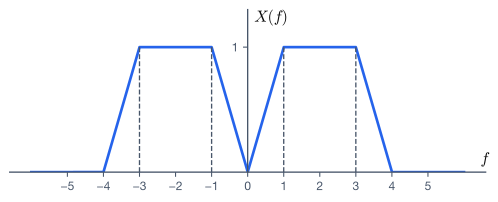
Let x(t) be a real signal with the spectrum X(f) of the figure, real and non-negative. (50 points)
- Compute its analytic signal x^{(a)}(t).
- Compute its Hilbert transform x_H(t).
- Evaluate the energy of x_H(t).
Exercise 2: solution
The positive part is a trapezoid centred at f_0=2, flat on |f-2|<f_1=1 and zero beyond |f-2|=f_2=2. As a convolution of two rects, of widths f_2+f_1=3 and f_2-f_1=1, with height 1:
X^+(f)=\mathrm{rect}\left(\frac{f-2}{3}\right)*\mathrm{rect}(f-2)\ \xrightarrow{\ \mathcal{F}^{-1}\ }\ x^+(t)=3\,\mathrm{sinc}(3t)\,\mathrm{sinc}(t)\,e^{j4\pi t}
x^{(a)}(t)=2x^+(t)=6\,\mathrm{sinc}(3t)\,\mathrm{sinc}(t)\,e^{j4\pi t},\qquad x_H(t)=6\,\mathrm{sinc}(3t)\,\mathrm{sinc}(t)\sin(4\pi t)
Check: x^{(a)}(0)=2\cdot\text{area of }X^+=6. The Hilbert filter keeps the energy, and by Parseval
E(x_H)=E(x)=\int_{-\infty}^{+\infty}X^2(f)\,df=2\left(\frac13+2+\frac13\right)=\frac{16}{3}
Exercise 3: power spectral density
X(t) is a WSS Gaussian process with zero mean and autocorrelation r_{XX}(\tau)=\mathrm{sinc}(\tau). The process is filtered through an interpolation filter with impulse response h(t)=\frac1T\mathrm{sinc}\left(\frac tT\right), so that Y(t)=X*h(t). (30 points)
- Evaluate the average power M_X.
- Compute the power spectral density of Y(t).
- Determine the value of T such that the power at the output is half of the total power M_X.
M_X=r_{XX}(0)=1,\qquad R_X(f)=\mathrm{rect}(f),\qquad H(f)=\mathrm{rect}(fT)
R_Y(f)=R_X(f)\,|H(f)|^2=\mathrm{rect}(f)\,\mathrm{rect}(fT)=\mathrm{rect}(fT)\ \text{ for }T\ge1
For T\le1 the filter passes the whole band and M_Y=1; for T>1, M_Y=\int\mathrm{rect}(fT)\,df=\frac1T, and M_Y=\frac12 gives T=2: the filter keeps |f|<\frac14, half of the band.
This was the last lecture. The exams and simulations of all four years are on the course page, as PDFs.
letizia.tech · Communications Engineering · University of Klagenfurt