Machine learning in communication systems
Lecture 1 · Machine Learning for ICE · University of Klagenfurt, 2023
This lecture
Lecture 1 of 8
A tour of a communication system, asking at each block one question: can a model learned from data do better than the one we derived by hand?
- The layers of a communication network
- The physical layer: transmitter, channel, receiver, and all three learned together
- From the data link layer up to the application
Machine Learning for Information and Communication Engineering (700.604) was a master’s course I designed and taught at the University of Klagenfurt. I first taught it in 2022: these slides are the 2023 edition, rebuilt for the web, so some of the content may be a little dated. All lectures.
The layers of a network
A network is described as a stack of layers. Each one serves the layer above and relies on the one below.
| Layer | Unit | Role |
|---|---|---|
| Application | data | network services for applications |
| Presentation | data | data representation, encryption |
| Session | data | communication between hosts |
| Transport | segments | end-to-end connections, reliability |
| Network | packets | path determination, logical (IP) addressing |
| Data link | frames | medium access, physical (MAC) addressing |
| Physical | bits | the medium, the signal, the transmission of bits |
Machine learning has found a use at every one of them. We start from the bottom.
The physical layer
01
The transmitter, traditionally
Information source a_k Source encoder efficient representation 010011 Channel encoder adds redundancy 010011111 Modulator bits to waveforms b_k(t) Physical signal
- The source encoder looks for an efficient (short) binary representation of the information.
- The channel encoder introduces redundancy, so that errors can be corrected: the result is a codeword.
- The modulator maps the binary sequence into waveforms that the medium can carry.
Each block is designed separately, from a mathematical model of its job.
The transmitter, learned
Information source a_k Transmitter b_k(t) Physical signal
Replace the chain with one block, optimized from data:
- optimal channel coding and constellation design
- joint source-channel coding
- investigation of the channel capacity
- digital predistortion of power amplifiers
The channel, traditionally
b_k(t) Communication channel the medium the waveforms propagate through c_k(t) + noise source n(t) {c_k(t)+n(t)}
The textbook channel is linear, with additive noise, usually Gaussian: the medium filters the signal, the noise is added on top. Convenient, and often accurate. Not always.
The channel, learned
b_k(t) Medium model {c_k(t)+n(t)}
Learn the channel from measurements when:
- there is no mathematical model for the likelihood (e.g. molecular communications)
- the model is known but too complex, and a simpler one can be distilled from it
- the relations are non-linear
- the noise is not additive, or not Gaussian
- the channel has memory
The receiver, traditionally
{c_k(t)+n(t)} Demodulator waveforms to codewords 010011111 Channel decoder uses the redundancy 010011 Source decoder rebuilds the symbol \hat a_k Estimated information
The receiver undoes the transmitter, block by block: from the received waveform to codewords, from codewords to bits, from bits to an estimate \hat a_k of the original symbol.
The receiver, learned
{c_k(t)+n(t)} Receiver \hat a_k Estimated information
- modulation classification
- localization
- better decoding algorithms (e.g. in satellite and optical communications)
Lecture 7 builds one: a neural decoder for a Hamming code.
End to end: the autoencoder
Input message s_k Transmitter x_k Medium model y_k Receiver Estimated message \hat s_k
Learn transmitter and receiver together, as one network with the channel in the middle:
\min\ \mathcal{P}\left[\hat s\neq s\right]\quad\text{subject to}\quad \mathbf{x}\sim p_X(\mathbf{x})
minimize the probability of error, under a constraint on the transmitted signal (for instance its average power). The whole communication system becomes an autoencoder: lecture 7 again.
From the data link layer up
02
Data link and medium access
Link and medium access control
- Spectrum sensing: is the band free? A detection problem.
- Automatic repeat request: will the decoder succeed? A binary prediction.
- Interference management: share the resources between users to maximize the throughput.
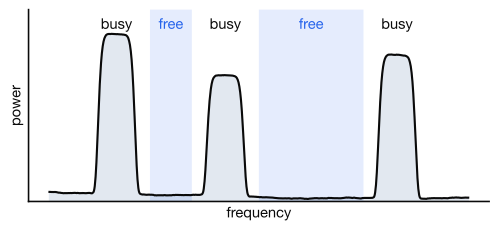
spectrum sensing: which bands are free?
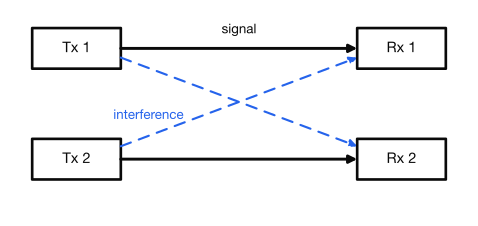
the two-user interference channel
Network and application
Network
- routing, as prediction of the optimal path
- anomaly and fault detection
- congestion prediction
Application
- caching at the edge: what will users ask for next? (classification)
- traffic classification
- community detection (clustering)
Further reading
- T. O’Shea, J. Hoydis, An introduction to deep learning for the physical layer, IEEE Transactions on Cognitive Communications and Networking, 2017
- O. Simeone, A very brief introduction to machine learning with applications to communication systems, IEEE Transactions on Cognitive Communications and Networking, 2018
- I. Goodfellow, Y. Bengio, A. Courville, Deep Learning, MIT Press, 2016
- J. G. Proakis, Digital Communications, McGraw-Hill, 2001
letizia.tech · Machine Learning for ICE · University of Klagenfurt