Sub 20 Minutes for 5K, on the Second Try
I missed sub 20 for 5K in the August heat, kept training, and ran 19:53 in an ordinary Thursday workout in Milan, eighteen months after my first run.
On the morning of 1 October I ran 5 kilometres in 19:53. It is the first time I have gone under 20 minutes, which means averaging just under 4:00 per kilometre for the whole distance. I started running about eighteen months ago, when a single slow loop was the whole workout, so this one took a while.
It also took two attempts. The first one, in August, missed by 16 seconds.
The attempt that failed
On 8 August, on the race day of my training plan, I went to Parco del Cormor in Udine at 7:50 in the morning. It was already 24 degrees. The loop there is about 1.6 kilometres, and its last stretch is uphill: not steep, but long enough that you feel it in the legs and, worse, you know it is coming on every lap. Five kilometres meant three of those climbs.
The watch kilometres went like this:
- 1 km: 3:59
- 2 km: 3:57
- 3 km: 4:05
- 4 km: 4:05
- 5 km: 4:11
I went through 5 kilometres in about 20:16. The first two kilometres were on target, slightly ahead of it even. Then the heat and the climbs started collecting, a few seconds per kilometre, and by the last one I was 11 seconds slower than I needed to be with nothing left to close the gap.
Not chasing it
It stung, mostly because 16 seconds is close enough to feel like a decision rather than a limit. The tempting response was to go out the following week and try again, angrier.
I did not do that. I went back to the plan and its ordinary weeks, the unglamorous sessions that do not end with a number worth sharing. Sub 20 stayed the goal, but it stopped being the point of every session. I trusted that if the training kept accumulating, the time would show up on its own eventually.
It did, in a workout I was not treating as an event.
The attempt that worked
On 1 October the plan had a 5K time trial scheduled for a Thursday morning. No bib, no race, no taper: a warm-up kilometre, two minutes standing still, then five kilometres on a flat park loop in Milan at 17 degrees.
- 1 km: 3:54
- 2 km: 3:58
- 3 km: 4:00
- 4 km: 4:03
- 5 km: 3:59
The total gap between the two runs is 23 seconds, and it splits almost evenly: I was 11 seconds ahead of August after 4 kilometres, and the last kilometre was 12 seconds faster (3:59 against 4:11). The October run faded a little in the middle too, but this time there was something left at the end.
What actually changed
The temperature. Seven degrees is the biggest difference between the two mornings. Heat makes the body spend part of its effort on cooling instead of running, and at 24 degrees that cost arrives early and keeps growing. At 17 it barely shows up.
The course. The watch recorded 18 metres of climbing in Udine and 2 in Milan. On paper that is nothing. In practice it was an uphill finish to every lap, and the mental side of seeing it coming each time was as tiring as the climb itself.
A warm-up. In August I started the effort cold. In October the easy kilometre beforehand meant my heart rate in the first fast kilometre averaged 177 instead of 171: already running, rather than spending the opening minutes waking up.
What did not change much was the effort. Average heart rate was 183 in August and 185 in October, with the maximum at 192 and 191. I worked about as hard both times. In August the conditions took a bigger share of that effort; in October more of it went into the pace.
The morning
 7:11, right before the start
 Kilometre 4, the 4:03 one
 Fast enough to blur the camera
 And then the watch said 19:53
Eighteen months, roughly
In May I finished my first half marathon in 1:38:18, at about 4:40 per kilometre. Sub 20 for 5K asks for 40 seconds per kilometre faster than that, over a quarter of the distance. Those are different kinds of hard. I track every run in StrideAtlas, which is how I could compare the two attempts from the data instead of from memory.
The mountain
This meme has been doing the rounds among runners, and it is the most accurate training plan I have seen.
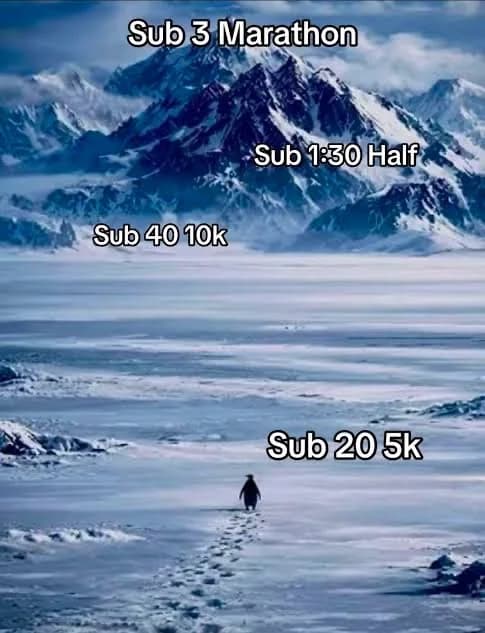
The sub 20 5K is at the bottom, on the flat part. Everything above it is steeper: sub 40 for 10K, sub 1:30 for the half, and at the top, the one I actually care about, a marathon in under three hours. That is about 4:15 per kilometre for 42.2 kilometres. My half marathon pace is still 25 seconds per kilometre slower than that, for half the distance.
It is a long way off. If August taught me anything, it is that the way up is to keep training and let the numbers arrive when they are ready.
More on the running side of my life lives at /hobbies/running.
Read next
My First Half Marathon, and What a Year of Running Taught Me
How a year of early-morning runs led to my first half marathon, the Stramilano in Milan, finished in 1:38:18, and what the habit changed beyond the race.
StrideAtlas: A Running Dashboard for Myself
Why I built StrideAtlas, a personal running dashboard, and what it shows that Strava doesn't.
What an AI Image Metadata Check Actually Proves
EU AI Act Article 50(2) asks providers to mark AI output so machines can detect it. What a metadata check proves, what it cannot, and a free tool.